Sunday, January 31, 2010

The Attachment-Based Supports and Services that Adoptive Children and Families Need

The suffering of too many adoptive children runs deep. It runs deep through the spirit and into the neurology of children traumatized by abuse, neglect, abandonment and loss of primary attachment figures. I am the endlessly proud mother of a beautiful, loving, brilliant adolescent adoptive son who I love so eternally that I often forget that I didn't give birth to him. However, in the face of uncanny cycles and life's triggers, I am reminded that as happy and well attached as my son is, no matter how fulfilling and joyful his life is now, the pain of his early history looms near. It is the quality of our support system that determines how well we can weather the storms when they arrive.

In my work with children and families, I am regularly stunned by the glaring deficit in our social service and mental health system's awareness of the special needs of adoptive children. Family after family wearily recounts to me the nightmare of going through multiple therapists, programs and services only to watch their adoptive children sink deeper into detachment, depression and rage. Frivolous use of psychiatric drugs, superficial diagnoses of "ADHD" and Bipolar Disorder, individual talk therapy, "anger management" and "self esteem" groups, behavioral charts and other misguided "treatments" serve to do little more than stall healing, exhaust the family, deplete hope and increase parent-child disconnection. In some cases, the result is a disrupted or rescinded adoption, a tragedy for the child who has already suffered excruciating abandonment and trauma. 

Adoptive children are some of our world's most resilient human beings. They may have been adopted at birth, but many of them have waited, sometimes for one year, five years, a decade, or until they almost "age out" of the system. (Some children do "age out" and never find "forever families"). They come from our own country and from other countries. They are children who may have lived in foster care, residential facilities, orphanages, or in the streets. They are children who may have been shuffled from foster home to foster home, never staying anywhere long enough to understand what love and family means. They are children who may have been abandoned or orphaned. They are children who may have been birthed by parents who were unable to care for them for a number of reasons. They may be children that have suffered physical, sexual and psychological abuse and neglect at the hands of birthfamily, or the systems that were supposed to "care" for them. Too many have been exposed to horrors that many adults couldn't endure. They all have a unique and individualized story. 

However, one thing adoptees share in common is an extreme break in the human attachment cycle. The human parent-child attachment cycle is the critical developmental blueprint of a person's lifelong emotional, social and spiritual health and happiness. The attachment cycle begins in utero and its quality is critical in the first three years of life. However, the attachment cycle must be maintained all throughout childhood. It is the quality of how well and completely parents respond to and satiate the physical and emotional needs of their children, leading to feelings of relief, trust, calm, joy, self-worth and homeostasis. These feelings create attachment. Parents that respond quickly, lovingly and in a nurturing, natural manner to the majority of children's physical, emotional and developmental needs enjoy a secure parent child-attachment, regardless of the child's age. 

In our culture, the more common scenario is that parents react to children's needs based on Western cultural norms. They meet some of their children's needs, partially meet others and offer culturally-sanctioned substitutes (bottles, cribs, jumpers, carriers, stuffed animals, pacifiers, punishment, playgroups, day care, traditional school, organized sports, TV, media, material objects, etc.) to children's most critical needs. These parents note mild to moderate behavioral, learning and emotional problems manifesting in their children as early as the toddler years or beginning in the adolescent years-- problems that our culture believes are "normal" aspects of growing up ("The Terrible Twos", "Typical Teenage Behavior"). This form of attachment is called insecure- The attachment cycle has been disrupted many times, but it is not broken. Problems often resolve in young adulthood or there may be lifelong emotional challenges for children to face.

In families who are outrightly abusive, neglectful or if the child was temporarily removed from the birthparents but returned, the attachment cycle is often severely disrupted. Severe behavioral, emotional and learning problems at any age are the natural results of this level of attachment disruption. However, when a child is  removed from the birthparents, either at birth or at any later age, placed in foster care, an institution or an orphanage and never reunified with the birthparents, there is a severe break in the parent-child attachment cycle. If there is trauma
involved, which is often the case, the break will be more damaging to the child. The behavioral, emotional and learning problems at any age can be severe, extreme or even catastrophic. The collection of symptoms typical of severe attachment breaks are known as Reactive Attachment Disorder (RAD).

Parents who adopt children into their lives are generally unaware of the parent-child attachment cycle, let alone of the break in it, or of the consequences it will have in their children's lives unless the correct treatment is found. They are often unaware that the break in this "primal" attachment cycle has neurological, psychological, physical, social and spiritual effects on their children. When they turn to providers to help them with the resulting alarming behaviors, they are often offered "treatments" that exacerbate the problem.

The attachment cycle is mammalian, and is critical to healthy development in all mammals, especially humans, yet it is overlooked and ignored in the fields of human services. Many social workers, mental health professionals, counselors, psychologists and especially psychiatrists do not even know what "attachment" is or the critical nature of the human attachment cycle. I can't count how often I have heard mental health professionals incorrectly use the words "too attached" to describe clingyness or a child who has separation anxiety with a parent. Ironically, these behaviors indicate a disrupted attachment, or not enough attachment! I even hear many well-meaning mental health professionals misguidedly use the word "attached" to describe a good therapeutic rapport with a client ("Oh, s/he is very attached to me"). Breaks in the human attachment cycle are often the origins of most forms of human psychological distress, including behavioral, emotional and learning problems-- Mental health and social work professionals are truly missing the holy grail of assisting the healing process in people!

So what do adoptive families need?

Adoptive families need attachment parenting education, a solid support network, respite services and a multi-modal treatment approach by professionals who specialize in attachment disruption or brain-based trauma treatments. Following is a list of the types of supports that re-energize families, services that help preserve families and treatments that heal trauma, attachment breaks and emotional disturbance in children. No single service will be sufficient; a multi-modal approach is necessary. 

Adoptive families need:

*Comprehensive post-adoption services from the adoption agency, including post-adoptive stipends, health insurance for the child and funding for respite services and other treatments not covered by insurance (especially for single parents or lower income parents),

*A network of experienced respite providers who can provide overnight care or care for a few days when the child's behaviors are exhausting the parents,

*A strong support system of extended family and friends who are willing to learn about the unique needs and struggles of adoptive children,

*A trauma specialist who uses the brain-based trauma treatment, Eye Movement Desensitization Reprocessing (EMDR)- This is a MUST!

*An attachment specialist who understands how to facilitate attachment in adoptive families, works respectfully and ethically with children and views the parents as part of the treatment team (Some examples are Theraplay practitioners or therapists trained in the Dan Hughes Dyadic Developmental treatment model). It is preferable if the attachment specialist can also do the EMDR.

*Education about attachment parenting and how to facilitate the parent-child attachment cycle with adoptive children (of all ages). Parents must learn how they can meet some of their child's early developmental needs for intense physical affection, connection and nurturing that were unmet or incompletely met in the first three years of life. This is also a MUST!

*Books, websites and resources that support the natural attachment parenting cycle (please see my website for a list of such resources), not the dangerous, power-and-control tactics of a small group of RAD charlatans that are popular online,

*A set of very basic Family Principles that outline the values of the home, a strong set of emotional stability tools for children to use to help them cope with mood swings and emotions, and clear cause-and-effect consequences for behavior that harms the parent-child relationship,

*Information and a support network assisting parents in homeschooling their child or enrolling their child in a child-centered school-- This is very important! 

*If homeschooling, a homeschool community-- This will provide children with wholesome, accepting friendships, social skill practice and offer less opportunity for children to become influenced by the toxic peer groups in public schools,

*24 hour crisis intervention services in the community (including mobile crisis response) that will respond immediatly to families in crisis and understand Reactive Attachment Disorder and PTSD,

*A formal or informal support agency or network of other adoptive families who can share emotional support, respite and resources,

*Funding for adjunct Neurofeedback treatment, a fun brain-based brain training treatment that is an alternative to psychiatric drugs,

*Adjunct treatment with a practitioner who teaches the powerful Emotional Freedom Technique (EFT),

*Funding for homeopathy and other naturopathic and body-centered treatments that are alternatives to psychiatric drugs,

*Testing to rule out food sensitivities in children,

*Information on how dairy, gluten (wheat), soy, refined sugar and non-organic foods can cause mood swings, behavioral and learning problems in children and how to switch to an organic, healthier diet,

*Resources for connecting children to community activities that they enjoy,

*If a child is unable to live at home due to severe behaviors, children need parents to continue their commitment to them through love, support, visits and a lifetime forever family,

*Family court and law enforcement responses that are sensitive to the unique needs of children with Reactive Attachment Disorder who are in crisis,

*Lawmakers who consult with adoptive families and who do not cut funding for vital services such as respite funding and post-adoption funding.
      Adopting a child requires a great deal of supports and resources. I have found many of the supports on the above list of supports, services and treatments to be essential for my own family and for many of the adoptive families I have worked with over the years. Some state adoption agencies, such as the state of Maine, lead the way in supporting adoptive children and families and provide a model that the entire country should emulate. It is crucial that social workers and mental health professionals receive the ongoing training and education that allows them to prioritize the parent-child attachment cycle and understand the unique needs of adoptive families.

      Monday, January 11, 2010

      "Avatar" Blues Can Be Cured with Real Life Activism and Radical Lifestyle Change

      This CNN article, "Audiences Experience Avatar Blues" http://www.cnn.com/2010/SHOWBIZ/Movies/01/11/avatar.movie.blues/index.html about moviegoers becoming depressed and suicidal after watching Avatar is troubling yet strangely hopeful. It is curious as well as shocking that people have been so asleep for so many centuries that only now that they have seen a computer generated movie have they become depressed by, shocked, outraged and aware of the severity of the loss of human life, of the loss of the natural, luscious beauty of our planet and of the loss of the joyous, symbiotic cultures that once inhabited the continent of North America. 

      I think it is testimony to how dull, arduous and downright painfully boring public school has presented history-- in attempts by our government to deter people from deeper inquiry and research into the truth behind the atrocities and genocide that our government has committed against the indigenous peoples of the world. A People's History of the United States by Howard Zinn is the real-life "Avatar" that every American should be reading.

      I suggest and hope that the mass numbers of depressed and suicidal viewers use their angst to rally together to save our very real life planet and the remaining peaceful indigenous cultures from further destruction and seriously rethink our society, our culture, our Government, our Capitalism and our worship of money and material objects. 

      Life does not have to be hurried, routine, difficult, painful, impersonal, mechanical, apathetic, media-obsessed, money obsessed and a struggle just to exist- We allow it to be that way by being part of a machine-like system that feeds off of money, compliance, ignorance, consumerism and apathy. This machine-like society that we have allowed to keep regenerating is the antithesis of everything  we need in order to be truly happy, joyful and free. Read Daniel Quinn's Ishmael  and Jean Liedloff's The Continuum Concept after you finish A People's History of the United States by Howard Zinn. 

      If you have seen Avatar and are depressed by it, try to refrain from wasting your time doing Google searches to drown yourself in fictional musings about the movie- Instead take real action to research the violence our society has been built on, the violence that it continues to do, how we have become the way we've become and how we as individuals can make an accumulative difference by doing something different- Returning to more natural, connected, authentic communities and ways of living.

      We can start to create a new way of life by removing our children from the clutches of the public school system and allowing them to grow up joyfully and free through unschooling or in schools like The Sudbury Valley Free School. We can join or create intentional communities, eat organic, unprocessed foods and "kill" (or atleast subdue) our television sets, our Blackberries and our endless, insatiable greed for material objects. We can put our children's needs as our first priority, cease punishing them and parent them for connection and attachment, whether they are infants or older adolescents. We can participate in real life activism for the planet, for trees, animals, for children, for the remaining indigenous cultures, for our communities and neighbors, our families and for the rest of humanity.

      We can't retreat in blissful escapism to "Pandora", but, as Ghandi challenged, "We must be the change we wish to see in the world" --This world. Earth. Our world.

      Friday, January 1, 2010

      Child Advocacy and Children's Rights Resolutions for the New Decade

      With every decade that passes, new legal and civil rights have been fought for and won for every group of adults in Westernized cultures. The fight continues around the globe in order to share those legal protections with oppressed populations in other cultures. With each passing decade, there have been landmark victories won that validate the journey for adults to assert their basic human rights- In the 00's, gay marriage was the fight that finally found victory in the United States.

      However, children seem to exist in a surreal incubator; a sterile laboratory in which they are viewed and treated as if they are human beings-in-the-making, like objects waiting to be assembled, or feelingless, spiritless bodies waiting for someone to bestow humanity onto them. Decade after decade passes, and yet an industrialized child's world always looks the same, with little more than trite hope of obtaining any real victories beyond the superficial "right" to be intoxicated consumers and technology automatons.

      In 1989, The UN Convention on the Rights of the Child was adopted by the United Nations and later ratified by all of the UN countries except for Somalia and...Guess who? The Land of the Free, USA. However, as with most well-meaning agencies, organizations, programs, task forces, experts and documents relating to "helping" children, the UN Convention is written by adults who assume they know what is best for children. While they are accurate on many accounts, they defer to stereotype and tradition in other areas, such as their gender-biased focus on only female victims and their freedom-violating article stating that education shall be forced ("compulsory").

      In most cases in history, oppressed groups themselves decide what it is they need, what is best for them and what rights would allow them to live with liberty, happiness and freedom. However, ironically, in the case of children, their oppressors are the ones who write up the documents, form the agencies, determine the "protections", divvy out the rights and choose the laws! Children are often offered only petty, insulting protections by "experts", agencies and spokespeople who can only see through adult-colored glasses; the "rights" children are given by adults often double as the "right" to be oppressed, abused or exploited by adults (For example, in all 50 USA states there are child abuse protection statutes in the books. However, in all 50 states parents are allowed by law to hit, smack, belt and physically hurt children as long as no physical injury results. In half of all public schools, school staff can legally assault children with wooden boards and actually leave injuries, with criminal immunity).

      Children form a large cohort of human beings- Children are people of all nationalities, colors, cultures, abilities, economic classes and of both sexes from the ages of birth to age 18. And some of us child advocates would argue that the fetus constitutes a child in need of consideration as well. Children constitute such an enormous group of people, yet this significant segment of the population lives every day in virtual slavery to adults and adult agendas, with no political power and virtually no voice for their needs, wishes, preferences and dreams beyond consumerism.

      It is easy to conclude that youth are too immature, uninformed, uneducated, self-centered, confused, lazy and consumeristic to be able to articulate their needs. This is not only ignorant and stereotypical, it is disrespectful and bigoted. If we listen to children, observe children, empathize with children, show compassion to children, play with children and decode the clues and messages underneath their stereotyped behavior, children will let true advocates know their needs. If we watch the span of children's years from birth to young adulthood and we allow ourselves to see how children react in the moment and over time to the seemingly "normal" everyday ways adults treat them, we will learn about children's true needs. We must stop assuming that when children cry, protest, resist, oppose, withdraw, conform, fear or form symptoms of "mental illness" or "disabilities" that they need more of what made them cry, protest, resist, oppose, withdraw, conform, fear or form symptoms.

      When we think of all of the major human rights movements in history, protest, resistance and outrage were some of the most common elements. Children are natural protesters and know better than anyone what they do and don't like and what they do need and don't need. Children, from newborns to teens, cry out, protest and attempt to fight for their basic human rights everyday, yet their protests fall on deaf, clueless ears. Parents, guardians, school teachers, school administrators, programs, professionals, psychologists, counselors, social workers, "experts", pharmaceutical companies, lawyers, lawmakers and governments (many well-meaning) exert crushing forces of effort to quiet, oppress, ignore, muffle and stomp out the cries and protests of unhappy children every single day in our society. This is accomplished through ignorance, apathy, laws, tradition, rules, control, coercion, punishment, threat, bribe, confinement, diagnosing, medicating, "servicing", "therapeutic" manipulation, thought and behavioral control, fear, intimidation, humiliation, shame, emotional and physical neglect, physical assault (Yes, that includes "spanking") and in extreme cases, severe physical abuse, sexual exploitation, physical and psychological torture or even murder.

      So What Should Child Advocates Do?
      The most basic and critical need of all mammal children, including human children, is for a secure, deep, permanent attachment to at least one parent, either by birth or adoption. Secure attachment is the result of a parent immediatly responding to and meeting the needs of their child, in a manner that is warm, loving and compassionate. The result of secure attachment is a parent-child relationship which is loving, warm, cooperative, respectful, healthy, and which grows stronger and more reciprocal as the child grows older. The youth who is angry, depressed, anxious, acting-out, disrespectful, withdrawn, materialistic or is showing symptoms of "mental illness" is not securely attached. The youth who is more interested in buying objects than spending time with parents is not securely attached. The youth who pushes away his or her parents and usually puts peers before family is not securely attached. The youth who bullies or lacks empathy for others is not securely attached. Parents who are cold, rigid, critical, authoritarian, permissive, disrespectful, indifferent, emotionally neglectful, punitive, abusive or who in any way fail to comprehend and respond to their children's needs cannot produce securely attached children.

      The human attachment cycle is the basic mammalian blueprint for a world-wide children's rights movement. The agenda of children's rights advocacy should be based upon the basic physical, emotional and developmental needs of children viewed from an organic, nature-based perspective, untainted by industrialized, religious, political or financial interpretation. Any other agenda is superficial and superfluous at best. At worst any other agenda is a front to protect adult power and control over children and financial and political agendas.

      Natural study of peaceful nonviolent tribal cultures as well as study of nonhuman mammals indicates clearly what our children need. This natural study may not show us what we as industrialized, busy, working, materialistic, politically motivated people wish to hear, but it will show us what true child advocacy is needed and why our children have been showing such distress for centuries. When infants cry, when children resist and when adolescents act out, they are telling their parents that they have a need that nature intended that the parents meet. In most cases, when children cry, resist and act out at all ages, they are crying out for physical and emotional connection to their parents, in whatever form is developmentally appropriate. They are letting us know they need something, that their bodies or emotions are uncomfortable. They are crying out for parents to understand that what we are doing to them or allowing someone to do to them is hurtful, painful or running against the grain of who they are (Yes, keeping children in oppressive school environments is hurting them).

      The multitude of blind traditions and expectations our culture has imposed upon children have caused our children intense distress. Their behavior and actions both as children and later as adults show us the severity of this distress. These blind traditions and expectations include, but aren't limited to: Infant-mother separation, bottle feeding, circumcision, crib sleeping, separation from a parent or extended family, punishment, coercion, control, physical punishment, "time-out", day care, school, sitting at desks, being forced to do busywork, lack of physical activity and play time, homework, toxic peer groups, segregated age groups, TV and media addiction, junk food, materialism, diagnoses, psychiatric drugs, programs/therapies to manipulate behavior and low levels of parental affection and connection.

      Infants need to be held day and night on the skin, breastfed for at least 2 and 1/2 years and allowed to share the family bed. Children of all ages need to be caressed, held, rocked, hugged, kissed and treated with empathy, warmth and tenderness. They need to be taken seriously, heard, cherished, understood and played with. They need your undivided time. They need to learn naturally from mistakes. They need strong, morally rich, compassionate modeling. They need to be protected from harmful people, harmful media and harmful influences. They need physical, intellectual and creative freedom. They need unschooling and community learning. They need free time to run, jump, play, explore, dream and invent. They need to learn in freedom, based on their own interests, dreams, passions. They need to learn in their own way, at their own pace, with their own learning style and using the resources, classes and mentors of their choosing. Children need to spend most of their time in play and increasingly as they grow older, in the community doing meaningful service. They need a diverse group of friends of multiple ages, young, old, child and adult. Above all, they need security, connection, love and compassion from their parents, families and mentors.

      Children also need adult advocates who empower children to stand up for their rights. They need adult advocates who will step in to protect abused, neglected or exploited children and their best interests fiercely when children are limited by the law or by adult control to do so for themselves. Children need adult advocates who do not taint their advocacy with adult agendas and motivations; who will not twist the words "best interests" to mean what the adult wants it to mean.

      We as a society need true child advocates and politicians to push for laws that truly protect children and their interests, heal the damage already done to children, and mentor and guide young adults to prevent them from passing on toxic patterns to their children. The child's needs are society's needs. When the child's needs are met, when the child's rights are established, fought for, respected and upheld, society begins to heal and becomes mentally, emotionally and socially healthy. When societies are healthy, the environment, the world and the planet begin to heal and become healthy and sustainable.

      The new year, 2010, is the gateway to a critical decade. What new rights will adult groups fight for and win? Will we leave children behind for another decade, in cribs, in daycare, in joyless 1800's-influenced school environments, with sedentary, tedious busywork? Will we leave children behind in front of TV and computer screens, engorged with sugar and fast food, overwhelmed and dulled down with fashions, gadgets and brand-names? Will we leave children behind segregated into cliques, riddled with diagnoses, drugged up with psychiatric chemicals? Will we leave children angry, sullen, depressed and disconnected from family and community? Will we continue to ignore and push aside children as if they have subhuman status while we rant and rave about our superficial political ideologies? Will we push our financial, political and ageist agendas for children under the guise of "child advocacy"? Or will we radically change the way we view and treat children, their rights and their needs?

      Tuesday, December 8, 2009

      Abuse/Neglect of Children is the Root of All of the World's Problems; Punishment Won't Heal, Only Attachment and Need-Meeting

      The story of the Plaistow NH father who bruised, bit and broke the bones of his three newborn triplets while the mother stood by passively praying, not calling the police, is just horrifying beyond all belief- The torture these baby boys and baby girl have endured is shocking to the conscience; I imagine for the adults to behave in this manner the same or similar must have been done to them- I have worked with children severely tortured this way as infants and when they are older youth, people expect them to behave normally. When they display severely disturbed behavior, "professionals" label them and do not seem to make the obvious connection between the torment in infancy and their current behavior. People who can't see the connection between childhood abuse (including spanking), neglect as well as poor parent-child attachment and later adult pathology are bound to be blind to the fact that the world's problems are a result of generations of this cycle of abuse and neglect of childen's basic needs. They are equally blind to the fact that healing the world won't be accomplished by punishment and hatred, but by a return to human attachment, bonding and need-meeting.

      Sunday, November 29, 2009

      UN Convention on Rights of The Child: Why is Education Compulsory?

      Child advocate Louise Gordon sent me a message on Facebook today asking me my thoughts about the contradictions in The UN Convention on the Rights of the Child related to compulsory education and children's rights to freedom of thought and pursuit of knowledge. I've been familiar with the UN Convention on the Rights of the Child for at least a decade, especially concerning the international child advocacy work I have done with Parents and Teachers Against Violence in Education (PTAVE) for the past 12 years in efforts to abolish corporal punishment of children. The UN Convention is a universal, global children's rights declaration meant to protect the rights, freedom, dignity, needs and vulnerability of children in every country. Any child advocate knows children of all ages need protection from the exploitation they receive daily in our society from adults, which includes everything from the common day-to-day ageist subordination to the outright physical, psychological and sexual torture some children endure. Child advocates all over the USA have decried the fact that the USA is alone with Somalia as the only two member countries in the UN who have refused to ratify the UN Convention. This fact no doubt reflects a similar hypocrisy of the "Land of the Free" refusing to join the 25 other countries that abolished all corporal punishment of children in homes and schools starting in 1979 with Sweden.

      The Preamble of the UN Convention beautifully, almost poetically, outlines that the UN affirms "their faith in fundamental human rights and in the dignity and worth of the human person".. and that "everyone is entitled to all the rights and freedoms set forth therein, without distinction of any kind...", which would include children. The Preamble goes on to affirm that "childhood is entitled to special care and assistance", that the family is the natural, rightful and fundamental place for children and that the child has the right to "grow up in a family environment, in an atmosphere of happiness, love and understanding". The Convention is then paced with 54 articles, broken into three parts, all declaring basic human rights for children.

      Articles 12, 13, 14 and 15 protect a child's natural human rights to their own view points, freedom of expression, and freedom to "seek, receive and impart information and ideas of all kinds, regardless of frontiers, either orally, in writing or in print, in the form of art, or through any other media of the child's choice"; freedom of thought, conscience, religion and "peaceful assembly". The Articles protect parents who exercise their duties to assist children with these necessary aspects of learning and expressing. Article 27 protects children's rights to live in conditions that are "adequate for the child's physical, mental, spiritual, moral and social development"; Article 31 recognizes and protects children's basic biological need and right to play, rest and engage in the arts; Articles 34-37 protect children from physical, psychological and sexual assaults of all types. Article 37 emphasizes that a child should not be "deprived of liberty".

      This document sounds like the Utopian, deity-like validation that children everywhere, for centuries, have fantasized about behind their tears of frustration and rage. However, Louise pointed out to me the one little word that insidiously slithered its way into Article 28 of the UN Convention-- This word, in effect, virtually nullifies and makes trite Articles 12, 13, 14, 15, 27, 31 and 37 plus much of the Preamble relating to equality, liberty, freedom of thought, freedom to pursue knowledge, freedom to play: That word is compulsory-- meaning "mandatory", "enforced" or "coerced". The word is powerless by itself. However, when that single word is preceded or followed by the word education, this document of childhood equality and freedom suddenly has the power to imprison and hold hostage every child in the world under adult whim and authoritarianism.

      Let's examine Article 28 a little closer: It begins, "States... recognize the right of the child to education... they shall, in particular: (a) Make primary education compulsory and available free to all... [Italics mine]." If we put aside and remove the word compulsory for a moment, the Article simply states that children have the "right" to an education and that States and nations must make it available to children free of charge. By removing the word compulsory, this Article would be in congruence with the Preamble and the rest of the Articles-- It would simply state that children have the right to partake of some type of instruction offered to the public, free of charge, and that they could not be denied access to this instruction. This would support, affirm, validate and enforce children's right to freedom by making something available to them, free of charge, if they so chose it. Article 28 would be a democratic decree supporting children's right to pursue knowledge, instruction, education, thought, idea and creative venture in any buffet-style medley that they choose. However, by inserting the word compulsory next to the word education, the medley rots into an ugly, dictatorial, one-size-fits-all force-feeding tube crammed down children's throats by adults who think they best know the passions and purpose of each unique individual child.

      In other words, by inserting the word compulsory, children are not even given "the right" to refuse their "right" to education! Nor are children allowed the basic right of all human beings to explore, inquire, learn, grow, think, imagine, invent, wonder and pursue the means to satisfy their curiosities in a way that is right for them individually. Judging by the manner in which compulsory education has behaved towards children since the days of Prussian rule, compulsory means that instruction must be done by force, whether or not it goes against the nature of every neuron, cell, fiber, need and dream of most children... Compulsory in this context has proven that the only instruction that will be free of charge and made easily accessible to all will be an option so mediocre, so joyless, so mechanical, so Capitalistic, so developmentally inappropriate and so contrary to every instinct of childhood that the only way to keep children there and to make parents keep them there is to enforce it with the threat of the law.

      That is one "right" that children would never wish to have if they could understand how much of their childhoods would be abducted and tainted by that "right". Is the "right" to be held hostage, confined, graded, compared, programmed, indoctrinated, surveilled, labeled, belittled, subordinated, disrespected and denied of basic bodily needs, play, family time, socialization and free time a "right"? That is a "right" that children must be wondering, "where's the punchline?", what dark satirical comedy sketch did that accidentally fall out of?

      The UN Convention on the Rights of the Child is a critical declaration that has the potential to challenge world governments to recognize children as fully human citizens. It has the potential to insist that world governments ensure that children have the right to bodily, emotional, mental, cognitive, social and spiritual integrity and protection from abuse, harm and exploitation. However, in order for the water to be pure, the drop of arsenic must be removed; the UN Convention is just another patronizing token to children's lack of political power as long as the UN considers it to be a "right" for children NOT to have the right to refuse compulsory education.

      Friday, November 20, 2009

      Regarding the Phenomena of "Children Without a Conscience"

      Regarding the phenomena of "children without a conscience", conscience, or human moral/spiritual development, develops in the context of secure parent-child attachment or nurturing, loving caretakers. If a child has "no conscience" (total lack of empathy for the victim), they have had no sense of own their needs mattering to anyone or being met. These are the children of cold, indifferent, detached and often abusive parents. These children can be habilitated by loving, nurturing caretakers committing to them and showing strong leadership, firm sense of restitution and high expectations, as well as a huge amount of empathy, compassion, physical affection and care to the child's emotional and physical needs. Brain scans of Romanian orphans deprived of human attachment actually show that conscience cannot develop in love-deprived children.

      Saturday, November 14, 2009

      Exhausted by the Mainstream Drowning Out Natural Instinct

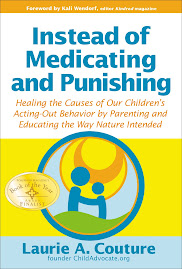
      My publisher suggested to me a few months ago that I should increase my book's visibility by blogging. Bloggers are everywhere, making it clear to me that blogging is one of the keys to viral marketing. Yes, I'm on Facebook and Twitter, and what I like about Facebook is the ability to post links and write small comments. I am a busy woman, and quick is what I need after a long day of working, overseeing my son's unschooling and taking care of the day to day chaoses of life. Thus, blogging has seemed like a chore.

      I stopped this morning and asked myself why I, a passionate writer who wishes to make a living at promoting my book and writing other books, would be anything other than ecstatic about writing a blog about attachment parenting, unschooling, and natural family living. The answer came as inertia glared down on my shoulders and eye lids: I'm exhausted by the mainstream. I am exhausted by how mainstream ignorance consistently and relentlessly drowns out nature's pleas with the human race to live in harmony with how we were intended by nature to live. I am exhausted by the bitter and hostile defensiveness of those too wounded by industrialization to even consider that the very problems they complain about are a result of our culture itself and our brainwashed belief that our way of life is the only way imaginable.

      Enlightenment can be excruciating, and a difficult process of life long self discovery, pondering, insight, understanding, guilt, remorse, grief, acceptance, application, re-evaluation, then further self-discovery. The knowledge to discover and the opportunities to refine, expand, re-examine and deepen our insights, is infinite. There are hundreds of thousands of enlightened people in our world. The number of industrialized people who are shedding the blinders and are living in harmony with nature are growing. I am energized, invigorated and overjoyed by bridging to, reading and dialoguing with such people. However, the mainstream mindset is so ubiquitous, that it can feel like my voice for natural family living principles is being drowned in a sea of ignorance- an ignorance that clings to-the-absolute-death to comfortable, yet poisonous ideals, no matter how much suffering those ideals cause humanity (especially children), animals, or our planet.

      I have come to see that despite it seeming as if the mainstream acculturation is far too frenzied, out of control and schizophrenic to grind to a halt, knowledge entails social responsibility. I believe that it is well worth the efforts to continue to add my voice, my writing, my passion and spirited social action to the small encampments, lighthouses and oases of enlightenment. It is well worth it for you to do the same. All of the books, magazines, websites, links, reviews, conferences, groups, meetings and people living in harmony with attachment parenting and other aspects of natural living symphony into beacons of unity. These beacons of unity support the voices of one another and assist and educate other people who are starting to turn away from our culture's addictive, superficial and mechanical solutions for the emptiness, disconnection, rage, apathy, anxiety and physical distress industrialized people are suffering.

      I'm glad authenticity won out over writing a blog entry just for the sake of it. I hope you'll join me in adding to that refreshing, beautiful symphony as a beacon of unity. Please check back here or visit me on Facebook or Twitter.